


On the scale from Toni Morrison and Joan Didion, who long leveraged notebooks to aid their story process, to the likes of Stephen King, who notoriously dismisses a companion pad due to the belief it’s the “best way to immortalize bad ideas,” I identify with the former, prescribing a great deal of importance to an everyday carry notebook that provides nothing more than a blank space for whatever passing thought, quote, observation, or even word I, in that moment, find worth preserving.
I’ve spent a year taming the writer's largest beast—the novel. From my teenage years into my early twenties, short-lived attempts were made with similar out-the-gate gusto. None sit curled by my side now. Those creatures never so much as complied to a call, let alone held a consistent name. Instead, they all roam the ever-expanding land of stray, surrendered thought.
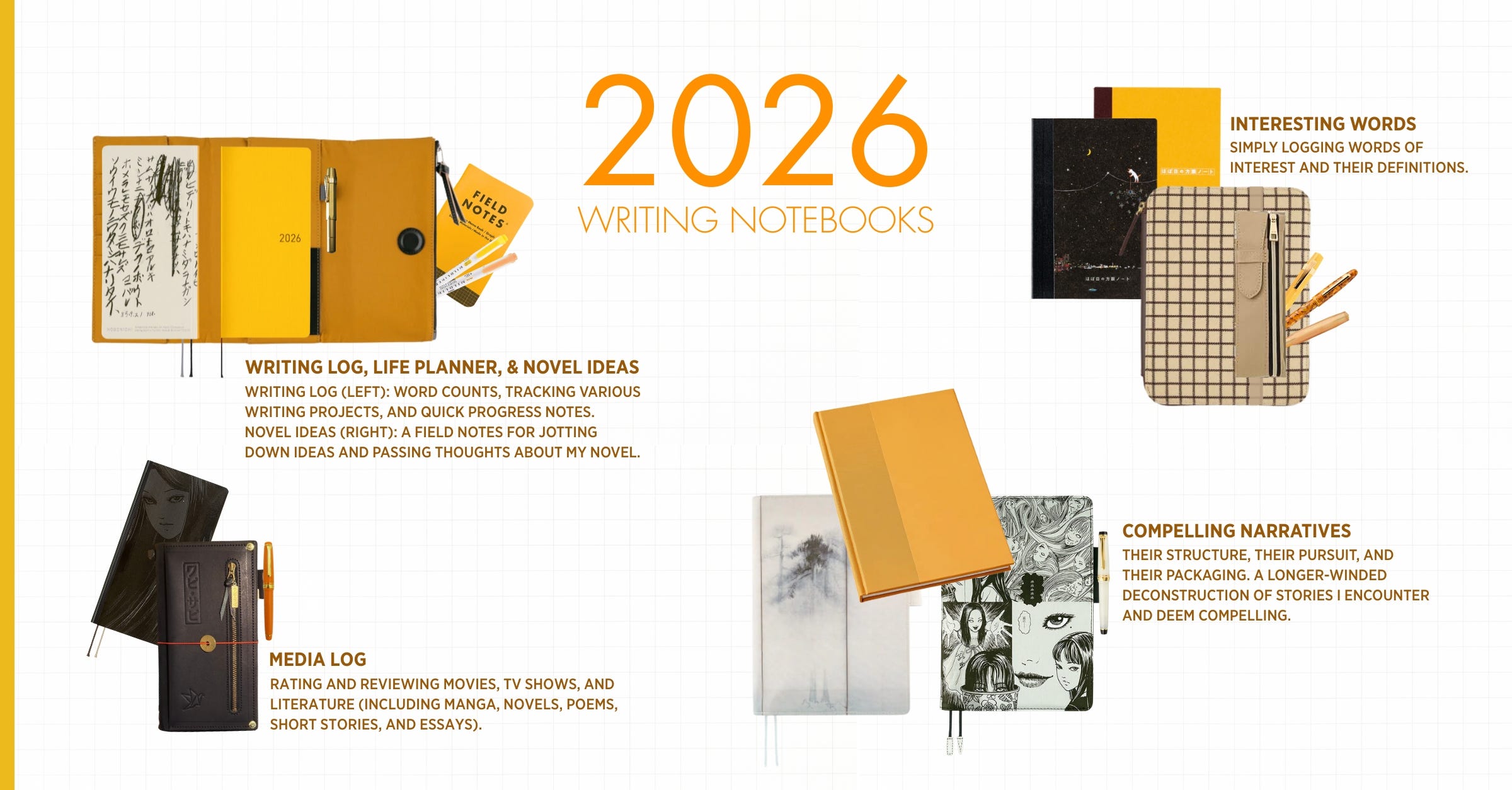
This recent venture has yet to suffer a similar release to the wild, which I attribute to a number of factors, but an undeniable one that resides surprisingly close to the top is the coordinated notebook system I’ve set for myself and, most critically, use with a level of consistency that mimics my approach to novel writing.
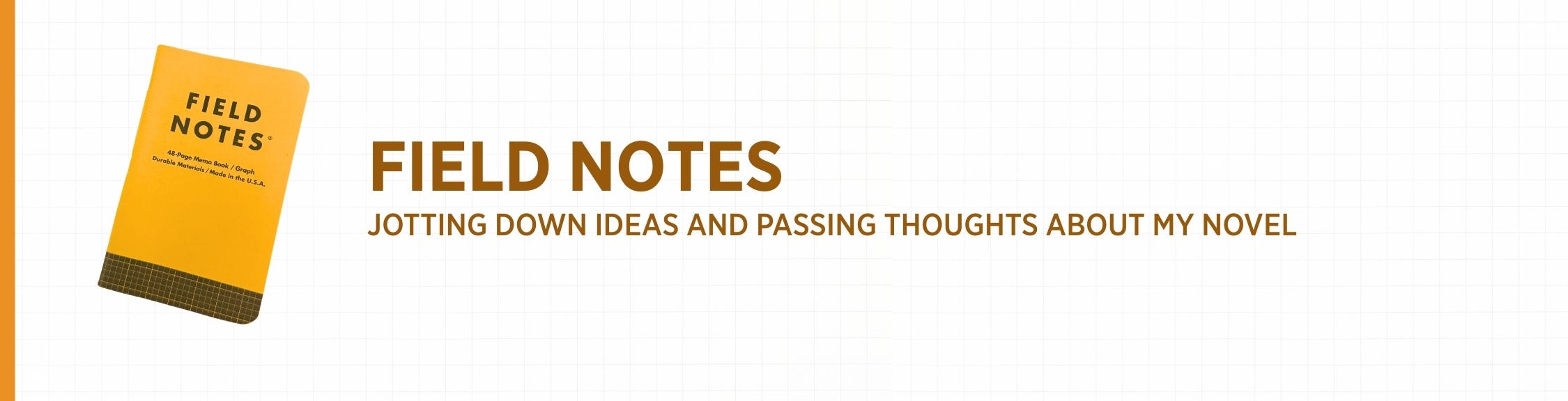
In the tail-end of 2024—a handful of months into this novel project—I dusted off another interest of mine: stationery. It’s not a head-scratching pair, especially given my preference for writing longhand. I always was a child with a diary, and come college, seldom spotted without my large A4 sized Passion Planner. But somewhere in the mirage of my twenties, I seemed to have left the longing for a pen and pad behind. I was thrilled to find the stationery community as lively and welcoming as ever once I stood at its door empty-handed. Soon, I possessed a pack of Field Notes notebooks and decided I should use them in a coordinated effort with my novel writing.
Initially, it was sometimes forgotten on my desk when I left for work. But it wasn’t long before it became as essential as my pen, both a companion and chief imagination officer. That Field Notes notebook was primarily used to harbor curious words or quotes and passing ideas for my story, as grainy as one line of dialogue or as capacious as a major plot point. It’s a fascinating flip through, this first notebook. From where I stand now, it reads as preliminary architectural drafts when held up to the structure well past breaking ground, with a confident, discernible frame.
I am my father’s daughter, so I find the idea of a land surveyor’s “field notes” type logbook most fitting for this dynamic of observing and engaging with our natural world. While he uses his for scribbling angles from his control points to the corners of houses in his direct line of sight, my deciphering verges more in the region of the intangible. Both terrains prove fruitful for documenting.
My last-ditch effort in suggesting Field Notes notebooks as a beneficial starting point: Lin-Manuel Miranda uses them.
I’m attached to these yellow grid field notebooks due to their thicker, fountain pen friendly paper. The small ruler flap printed in the back is a surprisingly useful touch. They’re no longer sold by the brand, but still available on platforms like eBay.
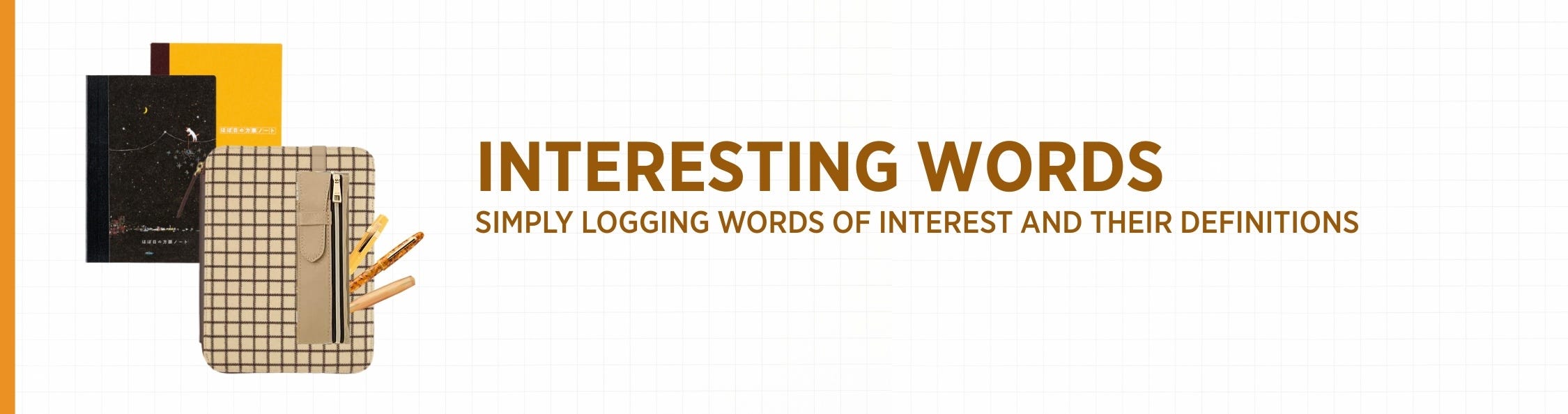
Once a routine formed with this pocket pal and more infrastructure was craved and called for, I expanded my singular setup by adding a larger A5-sized “Interesting Words” notebook to the mix. That way, there was one devoted space to consult vocabulary I deemed of interest, whether for a specific scene or simply because I enjoy its existence. There’s no parameter around needing to use them for my novel, though there has been one such occasion when I sought inspiration in this book while stuck in those paralyzing first paragraphs of a chapter. Noteworthy syntax starts from words. Why not construct a catalog of all the ones that, at some point or another, jumped out at you from a page, sign, or song?
The zipper case (available in both A5 and A6 size) is a standout from last year’s Hobonichi lineup called the Café au Lait Plaid. It’s expensive, but I cannot overstate its quality. The leather interior is stunning and will last a lifetime. While Hobonichi is a Japanese brand, their products are available through plenty of US retailers. The grid notebook I tuck in this zipper case is also from Hobonichi. Hiroko Kubota’s “Another night of falling star sparklers” is gorgeous, especially in a context where I impose myself and this notebook’s purpose into the artwork, catching words and stringing them along in my own curious constellation.
I can only speak for myself when I say, when in the throes of a story, the piece is always riding shotgun. It nudges the steering wheel when I overhear a strange exchange at the grocery store or when I’m completely unaccompanied while on a long walk. I’ve learned better than to try and understand the nature of how these curious interruptions work, and instead jot them down so as to not let the moment go undocumented and ultimately, out to pasture where those wild thoughts wander, never to be heard from again.
A way to work in tandem with this invisible guide, or as Brandon Sanderson puts it, “prime your mind,” is to utilize the otherwise empty spaces in your day, be it your commute or workout, to think through the next part of your story you’ll pen once at your desk. That way, you’re not sifting through musings of a concept for a half hour before things flow. This is one of the most impactful pieces of writing advice I’ve undertaken and continues propelling my narrative towards the finish line.
My commute to work is characteristically short, clocking in somewhere between eight and eleven minutes. For most, that’s a spectacular perk of the job. For someone aiming to devise their next unwritten chapter, it’s cruel. When I began implementing this Sanderson principle, I often found I was halfway up the hill of a good idea under this time constraint. But, after a good deal of regimentation, I noticed one day after I passed the house with yellow curtains, I’d produced a spark. Then, upon approaching the colonial on the corner nearly engulfed in vine, I’d molded something of note. This highly concentrated eureka didn’t occur every day. But nevertheless, an attempt was always made and, on the good days, frantically logged once parked.
On the days I knew where I was to take my story, I couldn’t resist using this time instead to deconstruct an existing and beloved narrative that wasn’t my own. I distinctly recall using one late spring commute to ponder over a movie my husband and I watched the night before, a childhood favorite of mine: Studio Ghibli’s “Castle in the Sky.” I hadn’t seen it since I was eight. For an adventure story that promises a mystical floating city called Laputa, we don’t actually spend much time perched up there. The majority of the movie is spent finding the castle while evading the government. Like Sheeta and Pazu, I began searching, trying my best to pinpoint what specifically in its composite made it compelling, both as a child and now as a thirty-year-old.
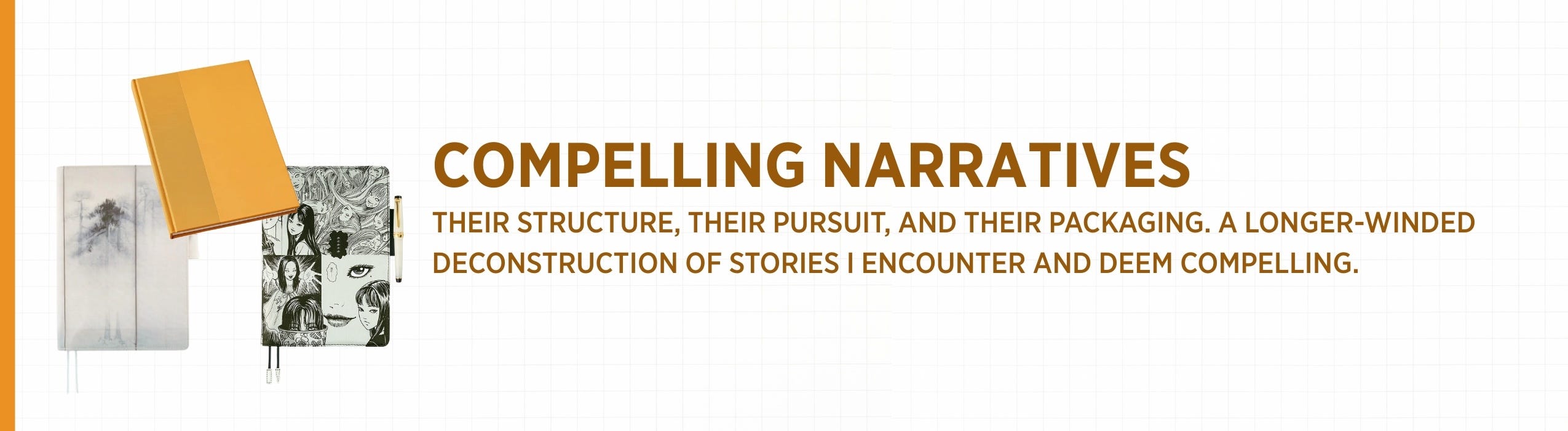
I believe that’s where I came up with the idea for my “Compelling Narratives” notebook, a hardcover A5 notebook that could accommodate long-winded analyses of story structure, pursuit, and packaging. If one is to pen their own compelling narrative, why not continuously evaluate what works for others?
The structure section is self-explanatory; it’s where I atomize the story until an arc reveals itself. Where might one find the midpoint? Why did the creator choose multiple POVs, and how did they go about divvying out such a task to its characters? Is the author adherent to the three-act approach? All are addressed in this part.
Coming off the heels of logic, I enjoy the subjectivity of the pursuit section, which encourages me to identify the creators' relationship to the story and why they were best suited to tell such a tale. What was their process like for constructing this piece? What’s their routine? If I’m up for the task, sometimes I’ll seek out the author's lineup of published work to compare, as this tends to elevate my understanding of who they were in that particular season of life.
I consider the realm of the visual a great deal. Naturally, packaging warranted its own section. Ever since I began reading chapter books, I found the “don’t judge a book by its cover” phrase (when applied to books) rather silly and frankly against human nature. It is my belief the author is just as responsible for the packaging as they are for its content, because no one else is as intimately acquainted with the story as its creator. The packaging of a book should be the acreage of the author, with the aid of artists who can render requests out of the author’s wheelhouse. This real estate is precious, and ever since we relegated this integral and sacred part of the story to pre-made templates and trends, it continues to deface a story’s value and desecrate the beauty that is a clever and complementary cover design.
Both my degrees uphold this conviction, and I will die on the hill that defends human-made art, for there’s no greater shame than resorting to non-human-made artwork to sell a story, which I can’t help but judge as soulless upon first glance. We must do our part to prioritize ornate beauty found in art that can only be made by humans with their own, individual lived experiences. For these reasons and a slew of others, I chose to analyze a story’s external contents and variations, because I will always see it as the story’s facial expression upon introducing itself. And a machine that has no face of its own will never understand how to participate in this ancestral exchange.
The star of the show, the bold, yellow A5 notebook, is from a German brand called Semikolon, which I sourced from my local stationery store, Merrymaker. The two covers I use for this notebook are rather unnecessary if judged strictly by utility, seeing as the hardcover notebook is plenty sturdy. But, to me, these covers provide added pockets and an undeniable flare of wonder, as the manga-style cover features actual panels from Junji Ito’s Tomie manga, his first and still widely recognizable work in the manga community. As a massive fan of horror and gothic, I find a lot of his tales inspiring.
Throughout the seasons of 2026, I plan on interchanging the Junji Ito cover with this year’s Hobonichi Pine Forest A5 cover, which was a special collaboration with the Tokyo National Museum. As stated on the Hobonichi site, “Pine Forest is a work of art that was painted by Hasegawa Tohaku nearly 420 years ago during the Azuchi–Momoyama period. He was believed to be in his 50’s when he painted Pine Forest. Some believe that Tohaku, who lost his son at a young age, may have painted this image from memory while imagining the coast of his hometown where he walked with his son.” I can’t help but think of my Virginia blue ridge mountains in winter when I see this cover at my desk.
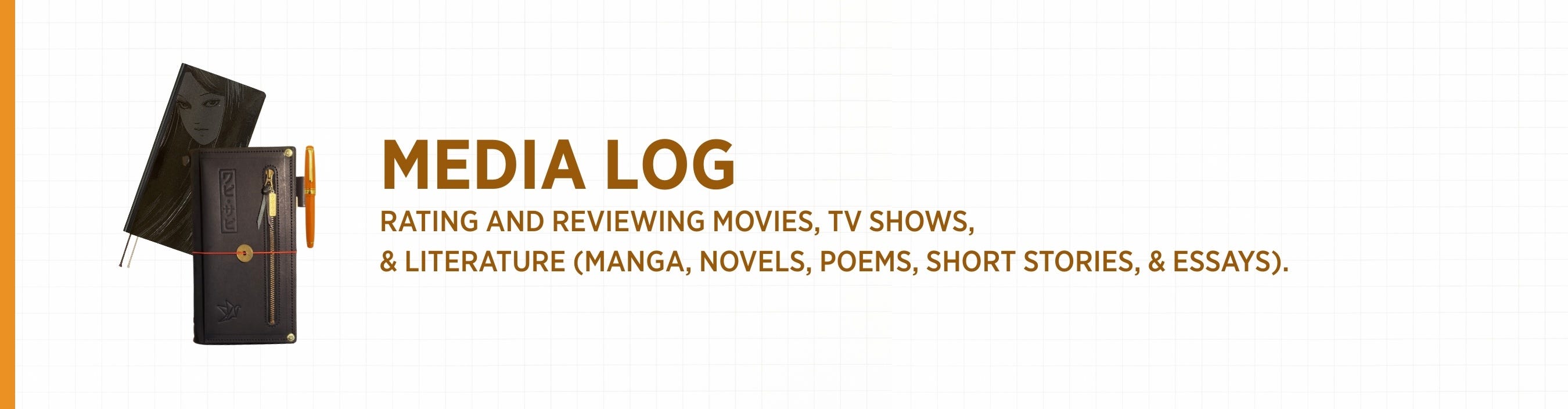
If not glaringly apparent by now, reflecting on a piece of media I believe to be a valuable use of time. If anything, we don’t do it enough. That’s one of many things that frightens me about social media—the way it erodes our sense of sitting with something for longer than thirty seconds. I’m certainly not immune.
Before I’d conceived of the “Compelling Narratives” notebook, I was already doing a granular version of it for months, dead set on combating doomscrolling by intentionally logging and rating creative media I engaged with, including novels, anime, graphic novels, short stories, and movies. It’s one of the notebooks I cherish most from my curation this year, and I found genuine improvement in my retention and recall when asked what I thought of a work months later. There’s considerable research that supports the idea that writing longhand boosts your ability to both learn and remember. So with all this in mind, I knew I wanted to not only continue a media log into the new year, but take it up a notch.
Rivaling my love of Field Notes is Hobonich’s “weeks” product, a slim planner from the brand’s annual collection that often features highly sought-after artist collaborations. I found this year I crammed too much into one small hobby-logging Traveler’s Notebook grid insert, so the idea of utilizing a Hobonichi weeks entirely for media logging seems like a sensible switch-up. I’m eager to give it a try. Most who are well-versed in the world of planners probably associate the weeks product as strictly for task and general life management, and understandably so, as that’s its intended use case. But I love the idea of seeing media I was engaging with at both a monthly and weekly glance, with 74 blank pages in the back for beefier reviews. Plus, the Junji Ito weeks design was far too grand a spectacle to not be the face of this endeavor.
For those curious to know the cover I plan to keep this Hobonichi weeks inside, it’s the Traveler’s Notebook regular in black, which I customized through Baum Kuchen’s Truly Yours service. You can either mail your beloved Traveler’s Notebook cover to Baum Kuchen or buy one through them to have it customized.
An ongoing list of authors who use notebooks in their story process:
Daniel Mason — his book “North Woods” still reigns as my favorite read of 2025.
F. Scott Fitzgerald — #3 in this compilation of tips.
R.F. Kuang — see the tiny nugget of insight in the last paragraph.
Ryan Coogler — humor me here: I know it’s not explicitly stated in paragraph five, but I refuse to trash my vision of Coogler drafting Smoke and Stack somewhere in the margins of a notebook.
Please feel free to comment other authors I should add and where they make mention of using a notebook.
This one Lin-Manuel Miranda story from when he was writing Hamilton lives in my head rent free: He was on the subway going to a friend’s birthday party and on the train he was struck with inspiration for Wait for It. So he showed up to the party, wished his friend a happy birthday, left, and then wrote the song immediately on his train ride home. Sometimes a commute can be great haha